Monte Carlo and Historical Retirement Simulation with Sequence Risk Analysis
A retirement plan can look very different when investment returns do not arrive in a smooth, predictable pattern.
WARPSimLab provides three ways to examine that risk: Monte Carlo simulation, Historical Windows analysis, and sequence-of-returns risk analysis. Each looks at retirement risk from a different direction.
Monte Carlo asks: What might happen across many possible future market outcomes?
Historical analysis asks: What would have happened if the same financial plan had lived through actual markets from the past?
Sequence risk analysis asks: What happens if poor returns arrive at a particularly bad time?
Together, they provide a broader picture of how uncertain markets can affect a retirement plan.
Why One Average Return Is Not Enough
Suppose a retirement plan assumes the portfolio will earn 6% per year. That can be useful for building a baseline projection, but real markets do not produce the same return every year.
A portfolio might gain substantially one year, lose money the next, recover later, and still average roughly 6% over a long period. During retirement, the order of those gains and losses can matter as much as the average return itself.
That is why retirement risk analysis needs to look beyond one assumed investment return.
What Does Monte Carlo Analysis Do?
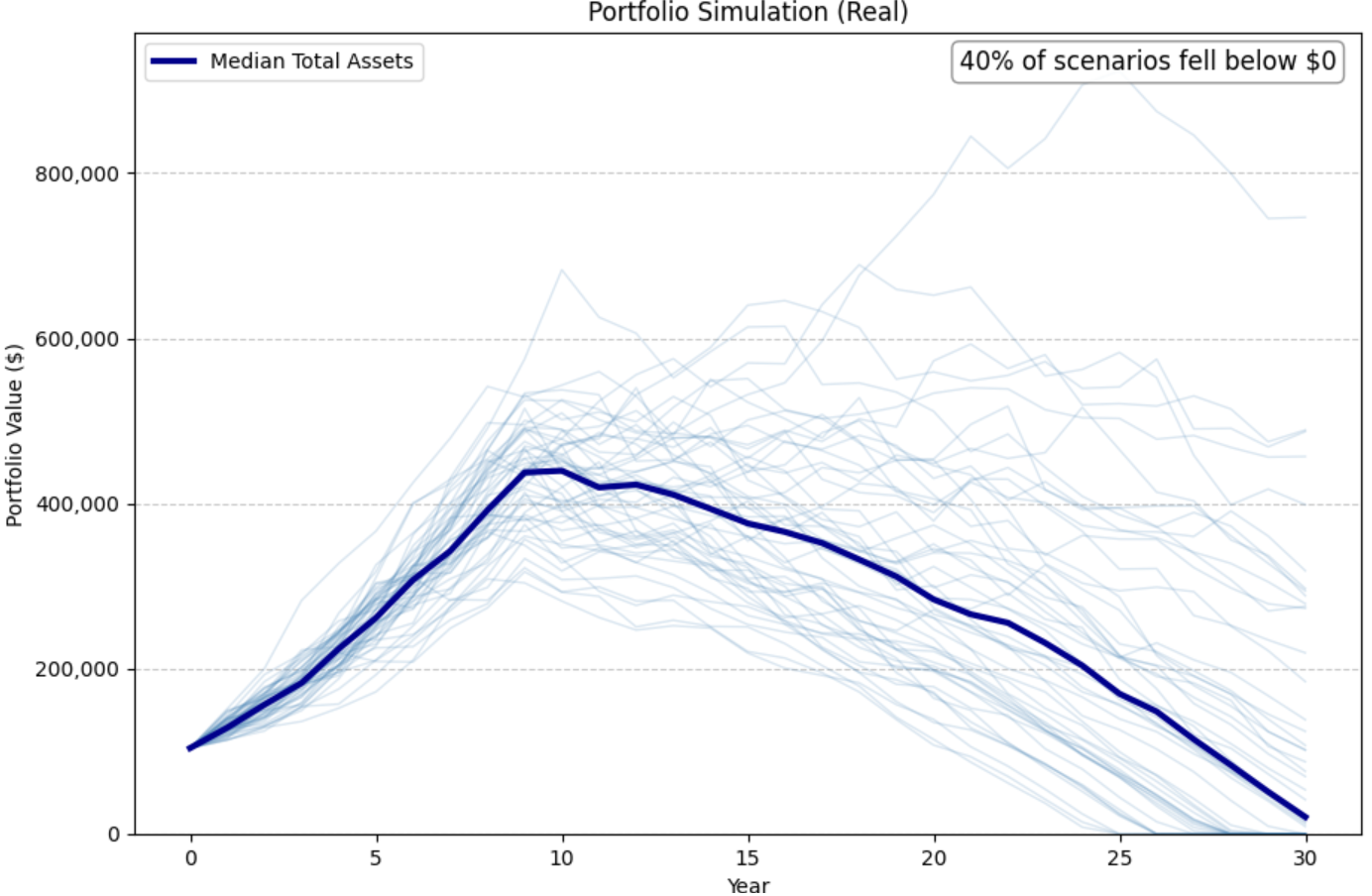
Monte Carlo analysis runs your financial plan many times over, varying investment returns around an expected average to reflect normal market ups and downs.
Each run creates a different possible financial path. Some runs may produce strong portfolio growth, while others may result in lower balances or eventual portfolio depletion.
Looking across many runs can show how often the plan remains funded, how widely the results vary, and how sensitive the plan is to uncertain markets.
Monte Carlo does not predict the future. It explores many possible futures.
What Does Historical Retirement Analysis Do?
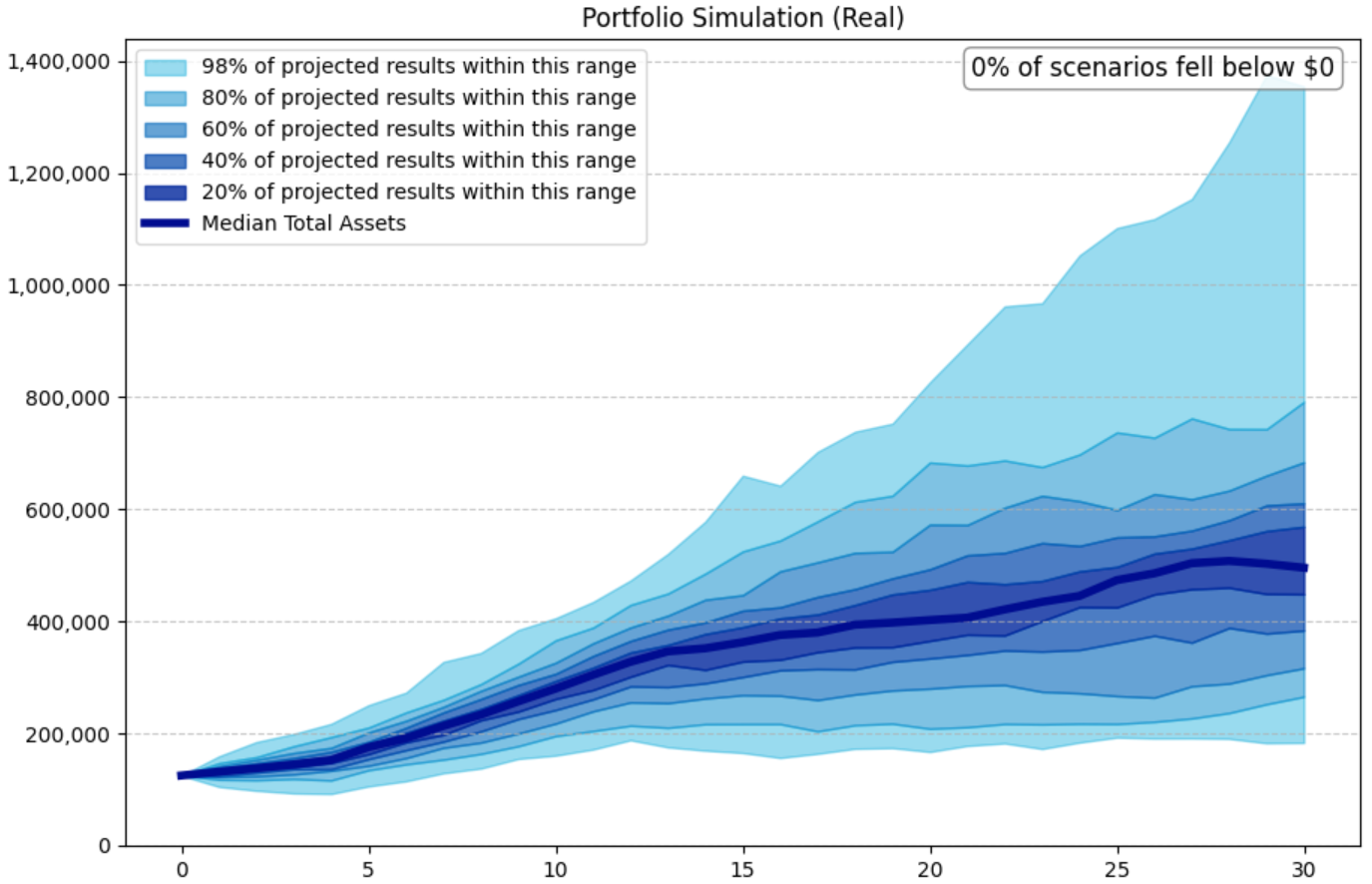
Historical analysis takes a different approach. Instead of generating possible market returns, it tests your financial plan against market periods that actually occurred in the past.
A retirement beginning during a strong market period may behave very differently from one beginning just before a major downturn, prolonged bear market, or period of high inflation.
WARPSimLab's Historical Windows analysis allows your financial plan to be tested across many different historical starting periods. That shows how the plan would have behaved during real market periods from the past.
What Is Sequence-of-Returns Risk?
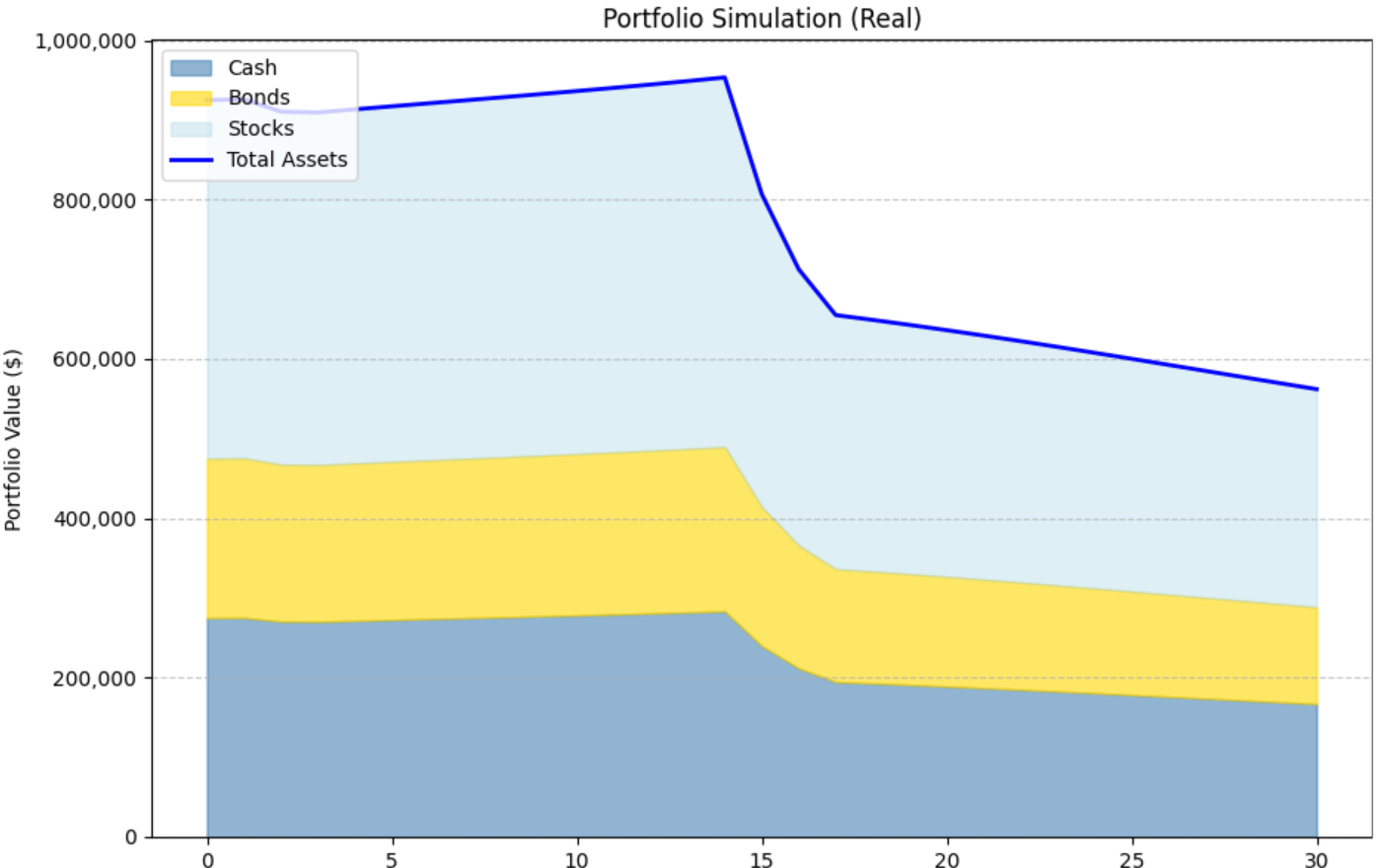
Sequence-of-returns risk is the risk that poor market returns occur at an especially damaging time.
This matters most when money is being withdrawn from your portfolio. Two retirees can experience similar long-term average returns and still have very different results if one encounters large losses early in retirement and the other encounters them much later.
Poor early returns can force withdrawals from a depressed portfolio, leaving less money available to participate in a later recovery.
WARPSimLab can explicitly test sequence-of-returns risk so you can examine how the timing of difficult markets affects your financial plan.
Three Views of Retirement Risk
The three approaches answer different questions.
Monte Carlo provides breadth by exploring many possible market paths. Historical Windows provides reality by testing your plan against markets that actually occurred. Sequence risk analysis lets you focus directly on the effect of poor returns arriving at an unfavorable time.
None of these methods tells you what markets will do next. Together, they help show whether your plan is sensitive to different kinds of market risk.
More Than a Probability of Success
Retirement risk analysis is often reduced to one number: probability of success.
That can be useful, but it does not tell the whole story.
Two plans can have similar success percentages while producing very different:
- Ending portfolio balances
- Retirement withdrawals
- Taxes
- Lifetime funding gaps
- Exposure to poor early markets
- Amounts remaining late in retirement
WARPSimLab lets you examine those differences rather than relying on a single percentage.
Test the Questions That Matter to You
Risk analysis becomes more useful when you compare different versions of the same financial plan.
What happens if you:
- Retire earlier or later?
- Start Social Security at a different age?
- Increase or reduce spending?
- Change your investment allocation?
- Change your withdrawal assumptions?
- Make a Roth conversion?
- Encounter poor markets soon after retirement?
WARPSimLab lets you change the assumptions, rerun the analysis, and compare the results.
The software does not tell you which choice to make. It lets the numbers help you understand the tradeoffs so you can make better choices for yourself.
Try WARPSimLab
WARPSimLab is a free, open-source retirement planning and personal finance simulator with Monte Carlo, Historical Windows, and sequence-of-returns risk analysis.
If you want to examine how your financial plan responds to different kinds of market risk, download WARPSimLab and run your own simulations.
How Monte Carlo Retirement Simulation Works
A Monte Carlo retirement simulation begins with a financial plan. That plan may include income, spending, Social Security, pensions, taxes, investment accounts, withdrawals, inflation, and portfolio allocation.
The plan is then run repeatedly, varying investment returns around an expected average to reflect normal market ups and downs. Each run produces a different result.
Looking across many runs helps show the range of outcomes produced by the data you enter and the settings you choose in the model.
Monte Carlo does not predict what markets will do. It shows how your plan behaves across many possible market outcomes.
How Historical Windows Analysis Works
Historical Windows analysis uses actual past market data instead of simulated returns.
The same financial plan can be started at different points in the historical record, exposing it to different market conditions. Some periods may include strong early returns, while others may include crashes, inflation, weak markets, or long recoveries.
Comparing those periods helps show how sensitive your plan is to the timing of real historical events.
Historical analysis is not a prediction. Future markets do not have to repeat any particular period from the past, and historical data only contains conditions that have already occurred.
That is one reason Historical Windows and Monte Carlo analysis complement each other: one tests your plan against real past markets, while the other explores many possible futures.
Sequence Risk Deserves Its Own Test
Monte Carlo and Historical Windows can both reveal sequence-of-returns risk. WARPSimLab also allows sequence risk to be examined directly.
That matters because the timing of poor returns can have a large effect on a retirement portfolio even when the long-term average return looks reasonable.
Testing sequence risk directly makes it easier to answer questions such as:
- What happens if a major downturn occurs soon after retirement?
- How much does the timing of poor returns matter?
- Does the plan recover after an early market decline?
- How sensitive are withdrawals and portfolio balances to a bad early sequence?
This provides another way to stress-test the same financial plan.
Market Risk Is Only Part of the Financial Plan
Investment returns do not exist in isolation.
Poor markets can affect withdrawals, taxes, Required Minimum Distributions, and the balances in Taxable, Tax-Deferred, Roth, and HSA accounts. Strong markets can change those same relationships in the opposite direction.
WARPSimLab applies its risk analysis to the same year-by-year financial model used for income, spending, taxes, and withdrawals.
That means market risk is analyzed as part of the complete financial plan rather than as a separate investment calculation.
Monte Carlo, Historical, and Sequence Risk Retirement Software
WARPSimLab includes Monte Carlo retirement simulation, Historical Windows analysis, and sequence-of-returns risk analysis.
It also includes year-by-year financial modeling, Social Security, tax modeling, retirement withdrawals, portfolio allocation, Roth conversions, and detailed reporting.
WARPSimLab runs locally on Windows, Linux, and macOS. There is no subscription, no account to create, and no requirement to connect financial institutions or upload personal financial information.
WARPSimLab is designed as an educational personal finance simulation tool and is not financial, investment, tax, or legal advice.
Download WARPSimLab
If you want to examine retirement risk using possible future markets, actual historical markets, and the timing of poor returns, download WARPSimLab and run your own simulations.