Retirement Calculators vs. Retirement Simulators
A retirement calculator can give you an estimate. A retirement simulator can show you how your financial life changes over time.
That distinction matters because retirement is not one calculation. Income changes. Social Security starts. Taxes change. Required Minimum Distributions begin. Spending rises and falls. Investments gain and lose value. Major purchases happen.
A useful retirement model needs to follow those changes.
What Do Retirement Simulators Do?
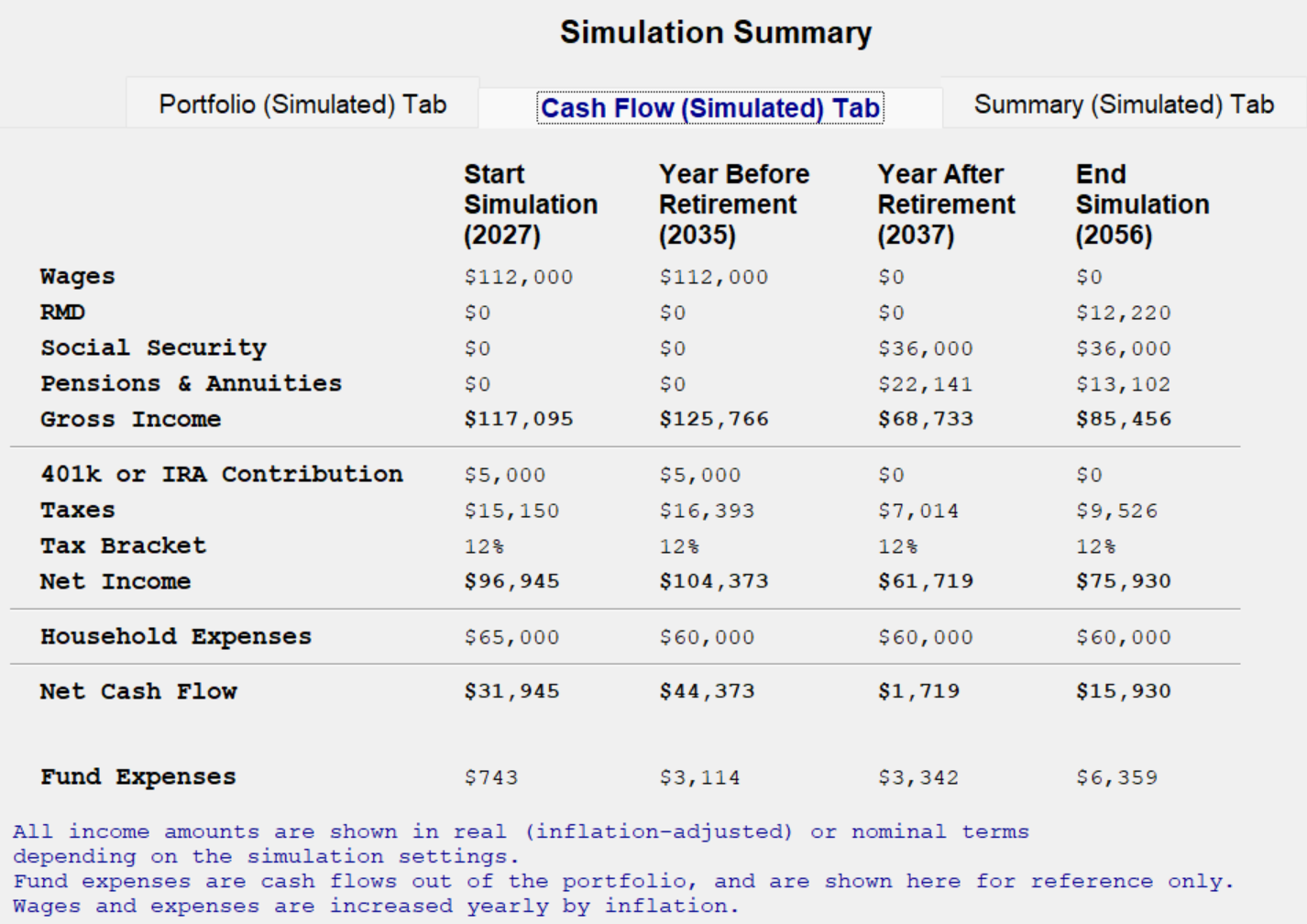
A retirement simulator follows your financial plan over time instead of reducing it to a single estimate. It models how income, spending, taxes, investments, and withdrawals change from year to year.
That can be useful when you want to see the big picture and understand how the pieces of your financial plan interact over time. It can show what happens when you retire, start Social Security, begin taking withdrawals, make a major purchase, or experience changing market returns.
Instead of compressing decades into a few assumptions and a final number, a simulator lets you see how the plan develops and why the results change.
What Do Retirement Calculators Do?
A retirement calculator usually answers one question using a small set of assumptions. It might estimate how much you need to save, how much income your portfolio could provide, or what your investments might be worth in the future.
That can be useful for a quick estimate. But a calculator often compresses decades of changing income, spending, taxes, and investment returns into a few assumptions and a final number.
It can give you an answer without showing much of the story behind it.
Why Does That Matter?
Suppose two people each have $1 million saved for retirement. That does not mean they have the same financial plan.
One might have most of the money in a 401(k), while another might have money divided between taxable investments, an IRA, Roth accounts, and an HSA. One may retire at 62 and start Social Security immediately, while another may work until 67 and delay Social Security.
They may spend different amounts, pay different taxes, and experience different investment returns. A single starting balance does not tell you how those plans will behave over the next 30 years.
A simulator can.
Test the Questions That Matter to You
A retirement simulator makes it easier to ask "what if?" What happens if you:
- Retire two years earlier?
- Delay Social Security?
- Spend an extra $10,000 each year?
- Remodel the kitchen?
- Travel more during the first ten years of retirement?
- Change your investment allocation?
- Make a Roth conversion?
- Experience poor market returns soon after retiring?
With WARPSimLab, you can change the assumptions, rerun the simulation, and compare the results.
The software does not tell you which choice to make. It lets the numbers show how different choices affect the long-term plan.
Try WARPSimLab
WARPSimLab is a free, open-source retirement and personal finance simulator.
If you want to see how your financial plan changes over time instead of relying on a single estimate, download WARPSimLab and run your own simulations.
Retirement Simulator Assumptions Matter
Every retirement simulator depends on assumptions. Common assumptions include retirement age, life expectancy, Social Security and pension income, retirement spending, inflation, investment returns, portfolio allocation, taxes, and withdrawal strategies.
A retirement simulator makes these assumptions part of a year-by-year financial model, allowing you to change them and examine how they affect the plan over time.
Retirement Calculator Assumptions Matter
Retirement calculators also depend on assumptions, but some may be fixed, simplified, or hidden from the user. A calculator might assume a constant investment return, a single inflation rate, fixed retirement spending, or simplified taxes.
Those assumptions may be perfectly reasonable for a quick estimate, but they can have a significant effect on the answer. The more assumptions you can see and change, the easier it is to understand what is driving the result.
Year-by-Year Retirement Simulation
WARPSimLab models a financial plan year by year. A simulation can include wages, Social Security, pensions, annuities, changing expenses, Tax-Deferred accounts such as 401(k)s and IRAs, Roth and HSA accounts, taxable investments, federal income taxes, Required Minimum Distributions, Roth conversions, retirement withdrawals, investment returns, asset allocation, rebalancing, and inflation.
These pieces are modeled together rather than as isolated calculations. That means a change in one part of the plan can affect other parts of the simulation.
For example, a Roth conversion may change taxes today while also changing future Tax-Deferred balances and Required Minimum Distributions. Retiring earlier may reduce earned income, change the timing of withdrawals, and increase the number of years the portfolio must support spending.
Retirement Taxes and Withdrawals
Taxes can be an important part of retirement planning. Money held in a taxable account does not behave the same way as money held in a 401(k), traditional IRA, Roth account, or HSA.
Withdrawals from different account types may affect taxable income differently. Required Minimum Distributions can also change taxable income later in retirement.
A retirement simulator can track these changes over time rather than treating the entire portfolio as one balance. WARPSimLab models taxes, retirement withdrawals, and multiple investment-account types as part of the same long-term simulation.
Retirement Spending Is Not Always Constant
Retirement spending can change over time. Travel may be higher during the first years of retirement. A mortgage may eventually be paid off. Healthcare or other expenses may increase later.
A major purchase such as a vehicle, home renovation, or vacation can also affect the plan. A retirement simulator can model these changes in the years when they actually occur.
That provides a different view from a calculator that assumes one constant annual spending number.
Risk Analysis
Investment returns do not arrive in a smooth, predictable pattern. WARPSimLab provides two ways to examine how market uncertainty can affect a retirement plan.
Monte Carlo analysis runs your financial plan many times over, varying investment returns around an expected average to reflect normal market ups and downs.
Historical Windows analysis tests your plan against actual past market periods.
These approaches provide two different perspectives on retirement risk: how your plan might behave across many possible futures, and how it would have performed through markets that actually occurred historically.
More Than Probability of Success
Many retirement tools summarize risk with a probability of success. That can be useful, but it is not the only result that matters.
Two plans can have similar success percentages while producing very different:
- Ending portfolio balances
- Taxes
- Withdrawal patterns
- Lifetime funding gaps
- Exposure to poor market periods
- Amounts remaining late in retirement
WARPSimLab provides detailed results so you can examine what happened inside the simulation instead of relying on a single percentage.
When Is a Retirement Calculator Enough?
A retirement calculator can be useful when you want:
- A quick estimate
- A rough savings target
- A simple future-value calculation
- A first look at retirement readiness
For those questions, a simulator may be more detail than you need.
A retirement simulator becomes more useful when you want to understand how multiple decisions interact over many years, such as retirement age, Social Security timing, spending, taxes, Roth conversions, investment accounts, portfolio allocation, and poor market conditions.
The difference is not that one tool is always better than the other. They answer different kinds of questions.
Free Retirement Simulation Software
WARPSimLab is a free, open-source retirement planning and personal finance simulator. It runs locally on Windows, Linux, and macOS.
There is no subscription, no account to create, and no requirement to connect financial institutions or upload personal financial information.
WARPSimLab is designed as an educational personal finance simulation tool and is not financial, investment, tax, or legal advice.
Download WARPSimLab
If you want to move beyond a quick retirement estimate and examine how your financial plan develops year by year, download WARPSimLab and run your own simulations.
Social Security and Retirement Timing
Retirement age and Social Security starting age do not have to be the same. A person might retire and begin Social Security immediately, retire and delay Social Security, or continue working while Social Security begins.
Each choice changes the pattern of income and portfolio withdrawals. WARPSimLab allows different retirement and Social Security starting ages to be modeled and compared.
This makes it possible to see how those timing changes affect cash flow, taxes, withdrawals, and long-term portfolio balances.